NCOA Survey: Older Adults Hold Social Media Platforms Accountable for Scam Ads and Call for Reform
PR Newswire
ARLINGTON, Va., March 31, 2026
Widespread, devastating scams are still vastly underreported
Key Takeaways
- Experience with social media scams is nearly universal among older adults, yet these incidents remain heavily underreported.
- Once older adults learn that social media platforms profit from scam ads, two-thirds hold them responsible for failing to prevent the spread of online fraud.
- Older adults strongly support proposed solutions such as strengthening advertiser verification and establishing clear legal accountability for paid scam ads.
ARLINGTON, Va., March 31, 2026 /PRNewswire/ -- Research conducted by the National Council on Aging (NCOA), the national voice for every person's right to age well, reveals that older Americans face an unprecedented wave of online scams. Once they understand the advertising practices of social media platforms, they demand reform.
To understand older adults' perceptions about social media scams and explore solutions, NCOA conducted an online poll and in-person focus groups with adults age 55+ in Phoenix, Ariz.; Detroit, Mich.; and Westchester County, N.Y. "Scroll, Click, Scam: How Social Media Platforms Enable Older Adult Scams" summarizes the findings and proposes a set of policy solutions to improve platform accountability and strengthen protections.
"It's shocking to see how universal and devastating scams are among older adults," said Ramsey Alwin, President and CEO of NCOA. "While we must educate people on how to recognize scams and protect themselves, individual responsibility only goes so far. Social media platforms must rein in scam ads instead of profiting from them, as they do now."
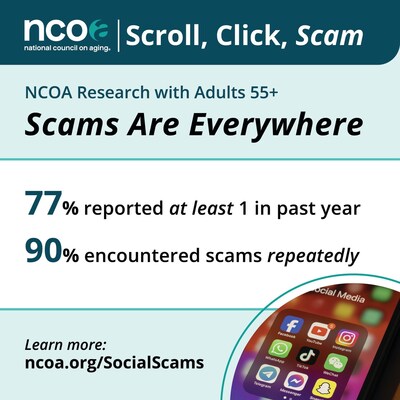
Three-quarters of research respondents either experienced an online scam or knew someone who had. Widespread exposure has made older adults think scams are inevitable, unstoppable, and too vast for any institution to meaningfully address.
Before learning about platform advertising practices, older adults were more likely to place the responsibility of fraud prevention on themselves and scammers than on institutions or industries. This reflects a common narrative that individuals are primarily responsible for preventing scams, even though they face sophisticated, persistent fraud tactics. The top three responses were:
- 27% assigned responsibility to individuals
- 25% assigned responsibility to those conducting the scams
- 22% assigned responsibility to social media platforms
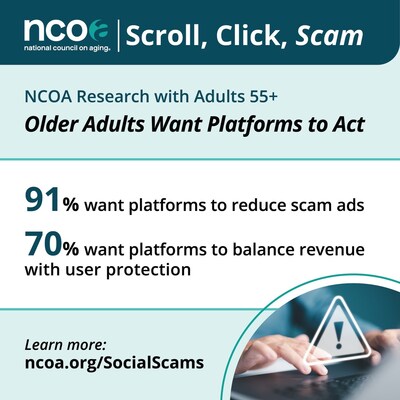
Over half of respondents (51%) were initially unaware that platforms like Meta profit from scams or misleading ads. Yet, when participants learned about Meta allowing numerous complaints before acting, their opinions shifted dramatically.
- 91% said platforms can reduce scam ads more than they currently do
- 67% said platforms are responsible for online scams
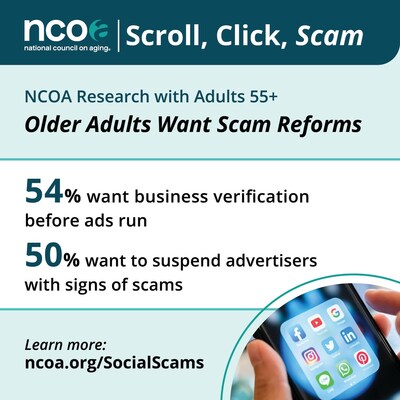
The majority of those who were scammed called for common-sense industry reforms. Among the top reforms suggested are:
- 54% supported requiring social media platform to verify businesses before they buy ads
- 50% supported suspending advertisers showing early warning signs of scams
- 34% supported allowing users to opt out of personalized ads
After being scammed, most older adults took some form of action, but they rarely reported it to authorities. Of those who were scammed, 37% contacted their bank, but only 18% reported the incident to law enforcement and 13% reported it to the Federal Trade Commission. This gap underscores how vastly underreported these scams remain.
"It's a fact that scams are intensifying and that they have devastating impacts on older adults' finances and health," Alwin said. "It's also a fact that scams are not inevitable. They are the predictable outcome of business models that prioritize revenue over safety—choices that can, and must, be changed."
When presented with a variety of proposed solutions, older adults expressed strong support for reforms such as:
- Strengthening advertiser verification and risk controls
- Improving detection, investigation, and removal of scam ads
- Establishing clear legal accountability for paid scam ads
- Enabling stronger federal and state enforcement
- Requiring immediate business practice changes by platforms
Full research results and solutions are available online at www.ncoa.org/SocialScams.
About NCOA
The National Council on Aging (NCOA) is the national voice for every person's right to age well. Working with thousands of national and local partners, we provide resources, best practices, and advocacy to create the conditions for everyone to age with health and economic well-being. Founded in 1950, we are the oldest national organization focused on older adults. Learn more at www.ncoa.org and @NCOAging.
 View original content to download multimedia:https://www.prnewswire.com/news-releases/ncoa-survey-older-adults-hold-social-media-platforms-accountable-for-scam-ads-and-call-for-reform-302729466.html
SOURCE National Council on Aging

