Climate Emergency Scenario Officially Sidelined says Friends of Science in Open Letter to Canada's Banking Superintendent
PR Newswire
CALGARY, AB, May 7, 2026
CALGARY, AB, May 7, 2026 /PRNewswire/ -- Friends of Science Society has issued an Open Letter to the Office of the Superintendent of Financial Institutions (OSFI) reporting that a widely used climate scenario known as RCP 8.5, has been officially sidelined by a climate sub-committee in charge of climate scenario design.
Climate policy analyst Roger Pielke, Jr. reports in "RCP 8.5 is Officially Dead", that the "climate emergency" scenario has been deemed to be "implausible." He writes: "The new scenario frameworks are the product of the "Coupled Model Intercomparison Project (CMIP)" — a project of the World Climate Research Programme (WCRP), co-sponsored by the World Meteorological Organization, the International Science Council, and UNESCO's Intergovernmental Oceanographic Commission."
Pielke, Jr., writes that the CMIP sub-committee's new set of scenarios will underpin the upcoming Intergovernmental Panel on Climate Change (IPCC) AR7 report, the findings of which are used to set government climate policies and direct banking and financial climate risk assessments.
Friends of Science Society have long made the case that RCP 8.5 was implausible and inappropriate for banking assessments of climate risks in previous Open Letters to OSFI and the Bank of Canada.
Canada's Changing Climate (CCCR2019) report, issued on April 1, 2019, by Environment and Climate Change Canada, was primarily based on the implausible RCP 8.5. The report used data from, "1948 and 2016, highlighting that Canada has been warming at roughly double the global mean rate." Subsequently, Canada proclaimed a climate emergency on June 18, 2019, and implemented a number of stringent emissions reductions measures.
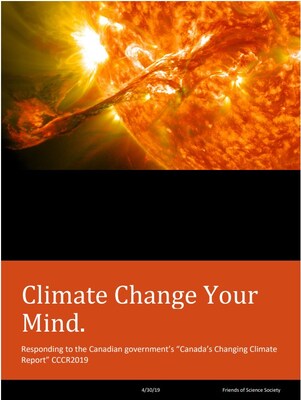
Friends of Science Society issued a rebuttal report titled, "Climate Change Your Mind: Rebutting the Canadian Government's Climate Report" on May 1, 2019. They noted at the time that, "The report was issued a day after the very unpopular federal carbon tax policy was implemented and as a constitutional court case began over the validity of a federally imposed carbon tax on the provinces."
Tom Harris of the International Climate Science Coalition challenged the claim that Canada is warming at twice the rate of the rest of the world, in a recent presentation at the Heartland Institute's 16th International Annual Climate Science Conference. Harris relies on the work of former Bank of Canada data scientist, Dr. Joseph Hickey, who found serious discrepancies in the long-term climate data records in Canada.
Hickey's report "Artificial stepwise increases in homogenized surface air temperature data invalidate published climate warming claims for Canada" indicates that in about 1998, there was a sudden, unexplained one-degree Celsius jump in climate data. This year coincides with the implementation of the Kyoto Accord, though that may be purely coincidental.
Data analysis by Friends of Science Society's president, Ron Davison, P. Eng., indicates that globally there was an incremental rise in other data sets due to an El Niño year, but the step increase was maintained, suggesting that the temperature jump was natural and not due to CO2.
More recently, Dr. John Christy (ret) of the University of Alabama Huntsville, has done a data analysis of the U.S. Historical Climatology Network (USHCN) record back to 1899. As reported in Phys.org on April 21, 2026, Christy found that "both hot and cold temperature extremes across the contiguous United States have declined over the past 127 years." Christy's paper was published in Theoretical and Applied Climatology.
The thrust of the Friends of Science Society's open letter relates to the committee charged with establishing Canada's 'green taxonomy', where OSFI's Superintendent Routledge is an observer. Canada has presented itself on the world stage as an energy superpower but lacks the pipelines and ports to make that a global reality. An Oct. 20, 2021, article contributed by retired energy economist, Robert Lyman, calculated that, "To sum up the previous sections, if they could be sold at present international prices Canada's fossil fuel reserves would yield gross revenues of about US $21 trillion."
Friends of Science Society says that with the impending global energy shock, renewables and green investments should not be top of mind. Intermittent wind and solar require reliable, dispatchable conventional back-up power generation. Otherwise, systems may face risks of blackouts, as Spain and Portugal experienced last year, as reported by CLINTEL. Friends of Science Society's "Net Zero and the Future Power Grid" discusses the challenges.
About
Friends of Science Society is an independent group of earth, atmospheric and solar scientists, engineers, and citizens that is celebrating its 24th year of offering climate science insights. After a thorough review of a broad spectrum of literature on climate change, Friends of Science Society has concluded that the sun is the main driver of climate change, not carbon dioxide (CO2).
Friends of Science Society
PO Box 61172 RPO Kensington
Calgary AB T2N 4S6
Canada
Toll-free Telephone: 1-888-789-9597
Web: friendsofscience.org
E-mail: contact(at)friendsofscience(dot)org
Web: climatechange101.ca

 View original content to download multimedia:https://www.prnewswire.com/news-releases/climate-emergency-scenario-officially-sidelined-says-friends-of-science-in-open-letter-to-canadas-banking-superintendent-302765859.html
SOURCE Friends of Science Society

